

WEEKLY MARKETS BRIEFING
Friday, March 26, 2026 | Issue No. 12
By Isaac Jonas | Principal Consultant, Streetwise Economics | www.streetwiseeconomics.com
| IMPORTANT DISCLAIMERThe views expressed in this briefing are my personal observations as an independent economist and are provided for educational and informational purposes only. Nothing written here constitutes personal investment advice, a recommendation to buy or sell any security, or a forecast of future prices. I am not a licensed investment adviser. Nobody — including me — knows where prices will be tomorrow. Markets are inherently unpredictable. Please consult a registered financial adviser before making any investment decisions. |
Market Snapshot — March 26, 2026
US Markets: Pressure From Every Direction
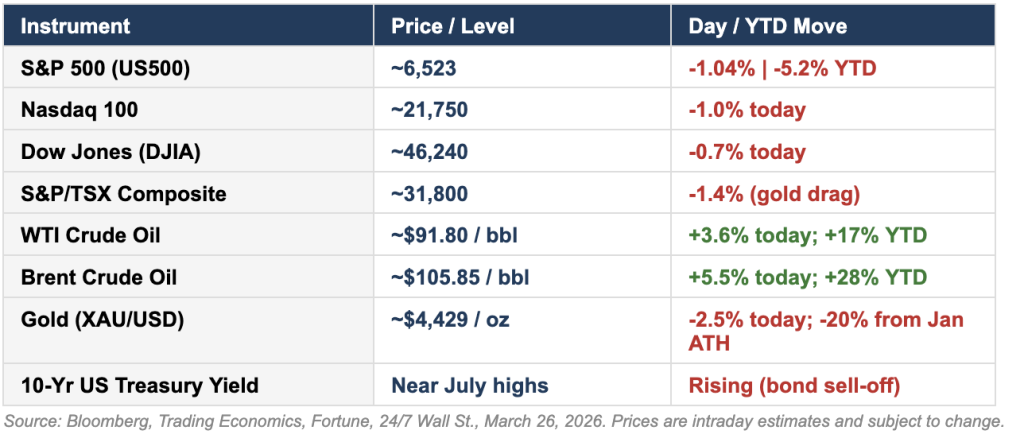
It has been another difficult week for US equities. As of Thursday, March 26, at the time of writing the S&P 500 was down roughly 1% on the session and is now approximately 5.2% lower year-to-date — on track for a negative first quarter. The Nasdaq 100 and the Russell 2000 small-cap index have fared even worse, with the Russell having entered correction territory last week. The Dow Jones has shown relative resilience, cushioned by defensive and industrial names, but it too is softer on the day.
What is driving the selloff? The honest answer is a convergence of forces that rarely arrive at the same time. First, oil prices are surging on Strait of Hormuz fears, squeezing corporate margins and pushing inflation expectations higher. Second, the Federal Reserve held rates steady last week — but the message from Chair Powell was not reassuring. With oil threatening stagflation, the Fed is in an uncomfortable position: it cannot easily cut rates when energy-driven inflation is rising, yet elevated rates are already weighing on growth. Recession probability models have moved sharply — Goldman Sachs puts the 12-month US recession risk at 30%, Moody’s Analytics at 48.6%, and EY Parthenon at 40%.
Third, technology stocks are under additional pressure from a separate front. Alphabet’s release of a new AI compression model — TurboQuant — has called into question demand for high-performance memory chips, sending Micron, AMD, Lam Research, and Applied Materials down more than 4% on Thursday. Meta fell nearly 7% after a California jury found its platforms harmful to minors and after the company announced layoffs. Microsoft, already underwater from a high cost basis in portfolios, slid another 2.8% on the day. These are not obscure names. They are the backbone of most retail investors’ growth portfolios.
My personal view: I focus on quality businesses — companies with durable competitive advantages, strong free cash flow, and the ability to survive economic cycles. In a market environment like this one, that lens matters. I am not telling anyone what to buy or sell. I do not forecast prices, and I never will. Nobody knows where markets will be tomorrow. What I will say is that volatility is the price you pay for long-term equity ownership, and periods like this are when investor discipline is tested most.
Canadian Markets: The Gold Paradox
Canada’s S&P/TSX Composite Index has had a difficult week, dragged lower by a sharp decline in gold mining stocks. This is, at first glance, counterintuitive — you would expect a war in the Middle East and rising energy prices to lift a commodity-heavy Canadian index. But the dynamics are more complicated.
Gold, which hit an all-time high of approximately USD $5,595 per ounce in January 2026, has fallen sharply in recent weeks and was trading around USD $4,429 on Thursday — down roughly 20% from that January peak. In Canadian dollar terms, gold was near CAD $6,100–$6,200 per ounce, still elevated by historical standards, but the direction is downward. Why is gold falling even as geopolitical risk rises? The answer lies in bond markets. As the Iran war pushes oil prices higher, traders are betting that central banks — including the Bank of Canada — cannot cut rates aggressively. Rising yields make gold, which pays no interest, relatively less attractive. It is a counterintuitive but well-established relationship.
For Canada specifically, the energy sector is benefiting from higher WTI and Brent prices — Canadian oil sands producers are seeing elevated netbacks — but that tailwind is being more than offset by the gold mining selloff. The TSX briefly wiped out all of its 2026 gains in the past week. Canadian households are also feeling the energy price shock at the pump, which adds to cost-of-living pressures that were already elevated.
Oil Markets: WTI Near $92, Brent Above $105
WTI crude is trading around $91.80 per barrel and Brent is near $105.85 as of Thursday morning — Brent is up 28% year-to-date from its January opening price of approximately $82.80. The $12–$14 spread between the two benchmarks reflects the premium global buyers are paying for seaborne crude while Middle East shipping lanes remain contested.
The proximate driver is straightforward: the Strait of Hormuz, through which roughly 20% of the world’s traded oil and LNG normally passes, has been severely disrupted since the conflict between the US, Israel, and Iran began on February 28, 2026. According to Lloyd’s List Intelligence, only 77 ships transited the strait in the first half of March — a fraction of normal volumes. Goldman Sachs described current pricing as reflecting a geopolitical risk premium above fundamentals, noting that global oil inventories across OECD nations are at critically low levels.
Oil markets have been on a rollercoaster of headline risk this week. On Wednesday, prices pulled back sharply after President Trump claimed the US and Iran were “in negotiations right now.” By Thursday morning, those gains were fully reversed after Iran’s Foreign Minister Abbas Araghchi told state media his government has not engaged in talks “and we do not plan on any negotiations.” Trump then hardened his stance, telling Iran to “get serious soon.” The signal-to-noise ratio in this conflict has been extremely high, and energy markets are being whipsawed accordingly.
The Tehran Toll Booth: Hormuz, the Yuan, and the Global Economic Order
I want to be very clear upfront: I am an economist, not a military analyst or geopolitical intelligence expert. What I can offer is an economic reading of what is happening, not a military assessment of how this conflict will unfold.
The most significant economic development of this week — arguably of this entire conflict — is what is now being called the Tehran Toll Booth. Iran has begun charging ships for safe passage through the Strait of Hormuz. The Gulf Cooperation Council’s secretary-general confirmed this publicly on Thursday. According to Lloyd’s List Intelligence, at least two vessels have already paid, and settlement was made in Chinese yuan. Iran’s parliament is now moving to formalize this arrangement with permanent fees — modelled, remarkably, on how Egypt collects Suez Canal tolls, except that Iran is charging for the privilege of not being bombed.
The fees being reported are as high as USD $2 million per voyage. Bloomberg sources note that shipping companies view this as a “bargain” compared to war-risk insurance premiums, which have surged since major P&I clubs — covering 90% of the world’s ocean-going tonnage — withdrew cover for Hormuz transits in early March. When the insurance system fractures, the dollar-based global shipping system begins to fracture with it.
The yuan dimension is the part that carries the deepest long-term economic significance. Iran is reportedly requiring — or at minimum, strongly encouraging — that passage fees be settled in Chinese yuan rather than US dollars. India’s government denied that Indian tankers have paid in yuan, but China’s vessels have reportedly been given privileged access to the corridor. China’s Cross-Border Interbank Payment System processed the equivalent of USD $245 trillion in yuan-denominated transactions in 2025 alone — a 43% increase from the year before. The infrastructure for non-dollar energy trade already exists and is growing.
This matters for the global economic order in a way that transcends the immediate conflict. The petrodollar system — under which most of the world’s oil is priced and settled in US dollars — is not just a currency arrangement. It is the foundation of American financial power: sanctions leverage, reserve currency status, the ability to borrow cheaply on global markets. If even a fraction of Hormuz oil trade moves into yuan-denominated settlement, it accelerates an existing trend that BRICS nations have been quietly building for years.
To be clear: I am not saying the dollar is about to collapse, or that the yuan will replace it as the global reserve currency. It will not happen quickly — China still maintains capital controls, its financial markets are not as open or liquid as America’s, and many nations are not eager to swap one monetary dependency for another. But trends matter. The Strait of Hormuz is becoming a laboratory for whether control over a physical chokepoint can be converted into leverage over the currency of global trade. This is a question with profound economic consequences far beyond the immediate war zone.
For everyday investors — especially those of us in the diaspora who hold US dollar assets while living in Canada — this is worth watching closely. Rising oil prices feed into inflation on both sides of the border, constraining central bank policy and squeezing consumer purchasing power. A weaker petrodollar, over time, could affect the relative strength of the Canadian dollar, commodity prices, and the long-term return environment for USD-denominated portfolios.
Global Markets: Europe, Asia, and the Emerging World
European markets slipped on Thursday as Brent crude pushed back above $100, reviving stagflation fears. German Defence Minister Boris Pistorius summarized the consensus view bluntly: “To make it crystal clear, this war is a catastrophe for world’s economies.” European TTF natural gas futures are up approximately 34% since March 1 as markets price in LNG supply route disruption through the Gulf. European central banks, like the Fed, face an impossible dilemma: inflation from energy is rising, but growth is slowing.
In Asia, China has the most complex exposure. As Iran’s largest oil customer before the war, China has reportedly been given preferential access to the Hormuz corridor — which explains why Beijing has stayed quiet. Chinese refineries have reportedly received 11.7 million barrels of Iranian crude since March 1, all settled outside the dollar system. For India, the picture is messier: India is a major importer of Middle Eastern oil, and supply disruption hits its energy import bill hard, even as its navy works to coordinate safe passage for its tankers.
Emerging markets, particularly those in Sub-Saharan Africa and South Asia that import the majority of their energy, are facing a compounding shock: higher energy prices, a stronger dollar (which makes their imports more expensive), and tightening global financial conditions. For African economies already managing post-pandemic debt loads, this is a serious headwind.

| FULL DISCLAIMERThis Weekly Markets Briefing is published by Isaac Jonas, Principal Consultant and Founder of Streetwise Economics (BC Sole Proprietorship, FM1037439). It is provided for general informational and educational purposes only. Nothing in this publication constitutes personal investment advice, a solicitation to buy or sell any financial instrument, or a forecast of future market performance. Isaac Jonas holds a Master of Food and Resource Economics (UBC), an MA in Resource, Environment and Sustainability (UBC), and a BSc in Economics (University of Zimbabwe). He is an independent economist, not a registered investment adviser. Past performance of any market or security is not indicative of future results. All market data cited herein is sourced from publicly available third-party sources as of March 26, 2026, and is subject to change without notice. Readers are strongly encouraged to consult a qualified, registered financial adviser before making any investment decisions. Streetwise Economics | www.streetwiseeconomics.com | isacjonasi@gmail.com | Abbotsford, BC, Canada |
Leave A Comment