

What the latest data shows — and what every diaspora investor needs to understand before committing capital
By Isaac Jonas | Economist, Streetwise Economics | 14 April 2026

Zimbabwe’s property market has produced some extraordinary headline numbers in recent years. Harare home prices are up 80% over five years. Diaspora remittances have crossed $2.45 billion annually. A major developer just announced the country’s first-ever 30-year mortgage. For Zimbabweans in Canada, the UK, the United States, and Australia who have been watching this from abroad, the question is natural and legitimate: does this market make financial sense for me?
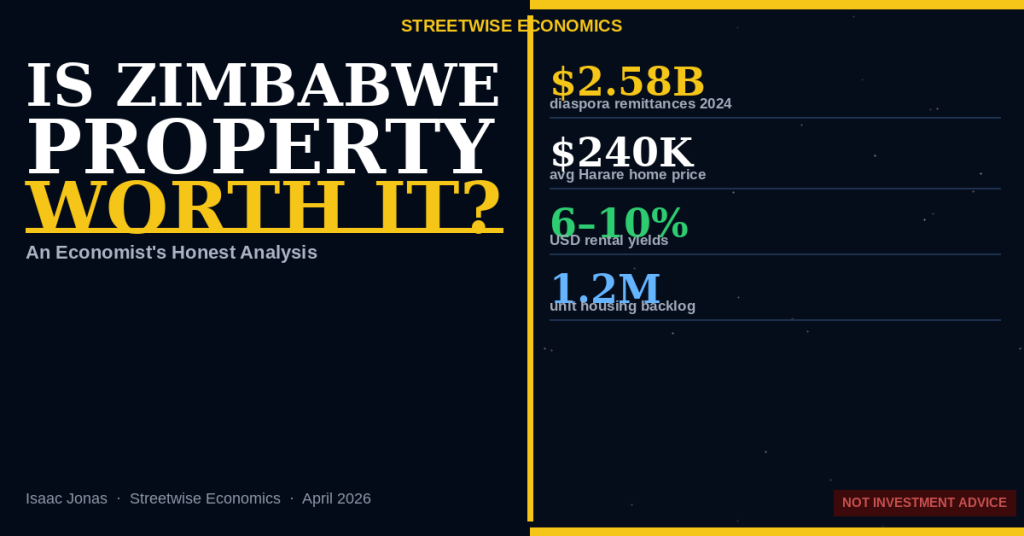
This article provides an honest economic analysis of what the data actually shows — including the parts of the story that are less commonly discussed. I have also set out four basic principles of investment valuation at the end, because no discussion of returns is complete without addressing risk.
The Remittance Picture — The Latest Numbers
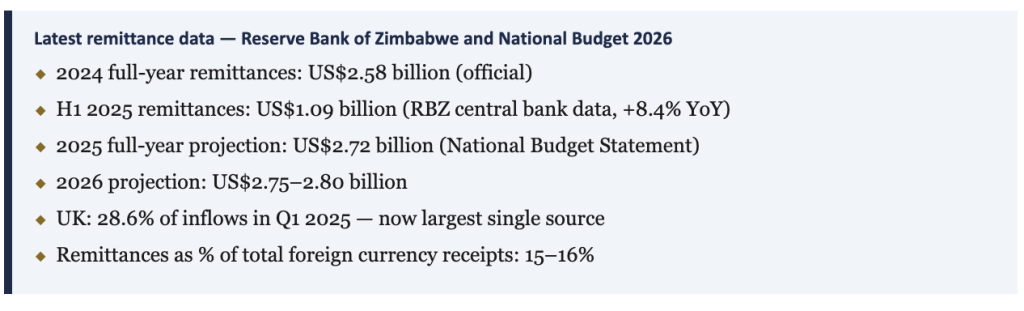
Start with what Zimbabweans abroad are already doing with their money. According to the Reserve Bank of Zimbabwe, diaspora remittances reached US$2.58 billion in 2024 — a 195% increase from US$922 million in 2019. In the first half of 2025 alone, the central bank recorded US$1.09 billion in remittance inflows, up 8.4% year-on-year. The government’s 2026 National Budget Statement projects full-year 2025 remittances at US$2.72 billion, rising to approximately US$2.80 billion in 2026.
Remittances now account for 15–16% of total foreign currency receipts — making them second only to mineral exports in importance to Zimbabwe’s foreign currency position. In the first quarter of 2025, the United Kingdom accounted for 28.6% of total inflows, overtaking South Africa for the first time, while South Africa contributed 27.5%. This shift reflects changing migration patterns: Zimbabweans in the UK tend to earn higher incomes in a stronger currency, which is reshaping the capital available for property investment back home.
The Property Market — What the Data Actually Shows
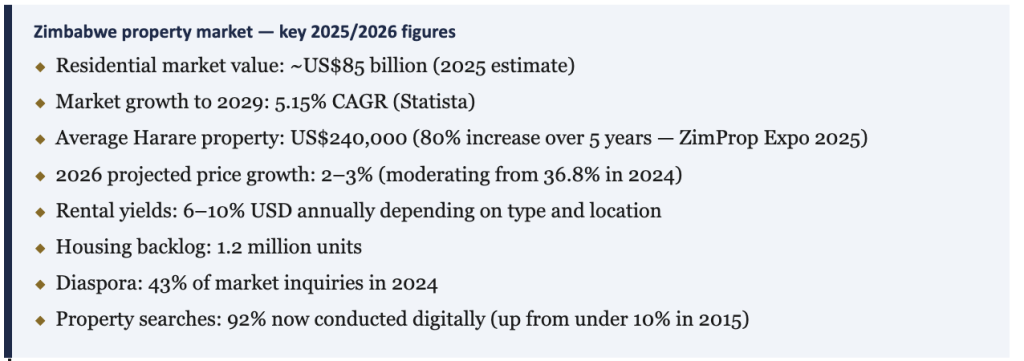
Zimbabwe’s residential real estate market is valued at approximately US$85 billion in 2025, with a projected compound annual growth rate of 5.15% through 2029, according to Statista market data. The average property in Harare now costs US$240,000 — equivalent to US$421 per square metre — representing an 80% increase over five years, according to the ZimProp Expo 2025. In premium suburbs such as Borrowdale, average prices approach US$860,000. At the more accessible end, middle-density two-bedroom homes trade around US$70,000.
Rental yields across Harare are reported in the range of 6–10% annually in USD terms, with variation depending on property type and location. City-centre apartments typically generate 6–8%, while well-located residential properties in high-demand suburbs can reach the upper end of that range. For comparison, residential rental yields in Toronto sit at approximately 3–5% and in London at 3–4%. The yield differential is real — but it exists for a reason, and understanding that reason is essential.

Here is the part of the story that requires honest acknowledgment. Property analysts including Equity Axis have described Zimbabwe’s market as ‘largely speculative, with buyers prioritising wealth preservation rather than rental income.’ The 36.8% price surge recorded in Harare in 2024 has moderated significantly: analysts project national price growth of only 2–3% in 2026. A market that ran extremely hot in 2024 has cooled. Investors entering now are not getting the same entry point as those who bought two years ago.
What the 30-Year Mortgage Actually Signals
WestProp Holdings announced Zimbabwe’s first-ever 30-year mortgage this month at Chivhu Eco City — a 5,000-hectare development 150 kilometres south of Harare targeting 20,000 properties. Until now, Zimbabwe’s mortgage market has been characterised by high deposit requirements of 30% or more and repayment windows of 10–15 years, placing formal financing out of reach for most buyers. The extension to 30 years is structurally significant.
Longer mortgage tenures tend to deepen property markets over time by expanding the pool of eligible buyers. Every mature property market — the United States after the 1930s New Deal reforms, South Korea in the 1980s, Kenya’s Nairobi in the 2000s — saw sustained demand growth when accessible long-term mortgage financing became available. Zimbabwe is at an early stage of this transition. Whether it holds depends on currency stability, interest rate management, and developer execution — none of which are guaranteed.
For the diaspora investor, the 30-year mortgage announcement matters because it suggests the market is building structural depth. It is an early signal, not a confirmed outcome. The appropriate response is to note it as a positive indicator while not treating it as proof of sustained appreciation.
The Risks — Stated Clearly
Any honest analysis of this market must address the risks directly. There are four that require specific attention.
Currency risk is the most significant. Zimbabwe does not have a stable domestic currency. The ZiG depreciated over 40% against the US dollar in September 2024 within months of its launch. The property market largely operates in USD, which is why the investment case holds — but any investor who is paid in local currency, or who intends to repatriate returns in local currency, is taking on substantial additional risk. USD-denominated transactions only, with clear exit terms in USD, is the baseline requirement.
Liquidity risk is real. Zimbabwe’s property market is not liquid in the way a stock portfolio is. Selling a property in Harare at the right price to the right buyer takes time — sometimes months. Capital that goes into property should be considered illiquid for a minimum of five years. Investors who may need access to funds on shorter notice should not be in this market.
Execution and title risk requires due diligence that many diaspora investors underestimate. Property scams involving forged title deeds and ghost developments are documented in Zimbabwe’s market. Verifying title documentation, developer track record, and compliance paperwork through a licensed legal professional in Zimbabwe is not optional — it is the minimum standard of care. The data in this article applies to legitimate, title-secured transactions.
Market concentration risk deserves mention. The Public Service Pension Fund of Zimbabwe has allocated nearly 47% of its assets to real estate. Local analysts have flagged that this level of concentration could create systemic pressure if property values stagnate. It also reflects that institutional money is competing for the same assets, which has contributed to the price surge and may limit future upside.

Four Principles of Investment Valuation — Applied Here
1. Risk-adjusted return is the only return that matters.
An 8% yield in Zimbabwe is not the same as an 8% yield in Toronto. The Zimbabwe yield carries currency risk, liquidity risk, political risk, and execution risk that the Toronto yield does not. A disciplined investor applies a risk premium to the Zimbabwe yield — reducing the effective comparable return — before deciding whether the investment makes sense relative to alternatives. A 9% gross yield in a market with significant currency and liquidity risk may be equivalent in risk-adjusted terms to a 4–5% yield in a stable market. That comparison still favours Zimbabwe in some scenarios — but only if the risks are genuinely manageable for that investor.
2. Entry price determines return.
After an 80% price increase over five years and a 36.8% surge in Harare in 2024, investors entering in 2026 are not getting the same deal as those who entered in 2020 or 2022. Price growth is now projected at 2–3% for 2026. The rental yield may still be attractive, but the capital appreciation story is more modest than the recent headlines suggest. Price matters at entry. An honest investment case for Zimbabwe property in 2026 is built on yield and long-term structural growth — not on repeating the price performance of the past five years.
3. Liquidity has a cost.
Every asset that is hard to sell quickly carries an implicit cost — the liquidity premium. Zimbabwe property is illiquid. The 6–10% yield partly reflects compensation for that illiquidity, not just reward for economic exposure to Zimbabwe. Investors who compare Zimbabwe property yields to liquid assets like ETFs or listed shares are making an imprecise comparison. The correct comparison is to other illiquid assets — private equity, direct lending, real estate in other frontier markets — where similar or better risk-adjusted yields may be available.
4. Due diligence is not optional — it is the return.
In a market where title fraud is documented and developer credibility varies, the difference between a good investment and a catastrophic one often comes down to the quality of legal and compliance verification before purchase. Diaspora investors who rely on informal networks or family connections without independent legal verification are accepting a risk that is entirely avoidable. The cost of a property lawyer in Zimbabwe is small relative to the transaction size. Skipping it to save money is the kind of false economy that turns a yield story into a loss.
My Honest View
The structural case for Zimbabwe property investment is genuine. A 1.2-million-unit housing deficit, a growing urban population, $2.58 billion in annual diaspora remittances, and a USD rental yield premium over Western markets are real economic foundations — not marketing claims. The introduction of 30-year mortgages is a positive structural signal for long-term market deepening.
The 2026 picture is more nuanced than the five-year headline numbers suggest. Price growth is moderating. The market ran hot in 2024 and the easy appreciation gains have been made. The investment case now rests primarily on yield and long-term hold value — not short-term capital gain.
For a diaspora investor with access to USD, a long-term horizon of seven to ten years, the ability to conduct proper title and legal due diligence, and capital they can genuinely afford to hold illiquid, the economics can be favourable. For an investor who is stretching financially, relying on informal networks, or expecting short-term gains, this is a market that punishes misjudgement.

Isaac Jonas is an economist and founder of Streetwise Economics. He holds dual Master’s degrees from the University of British Columbia and writes the weekly economics column for The Standard Zimbabwe. Economic research and advisory: www.streetwiseeconomics.com. This article is for informational and educational purposes only. It does not constitute investment advice. Always seek independent professional advice before making investment decisions.
Data sources:
- Reserve Bank of Zimbabwe — Foreign Currency Receipts H1 2025 .
2. Zimbabwe National Budget Statement 2026.
3. ZimProp Expo 2025 · Equity Axis (2025) .
4. Property.co.zw 2026 Market Outlook .
5. Statista Residential Real Estate Zimbabwe.
6. The Zimbabwean (November 2025) .
7. ZiGoats (January 2026) .
8. WestProp Holdings (April 2026).
Leave A Comment