

A plain-language brief on Canada’s 2026 “technical recession”
Isaac Jonas · Streetwise Economics · June 2026
Companion brief to Streetwise Economics Working Paper 2026-02. Full paper and data available at streetwiseeconomics.com.
The short version
Canada just recorded two quarters in a row of shrinking economic output, which by the usual rule of thumb means a recession. But the word is doing more scaring than explaining. The economy didn’t actually shrink in any meaningful way last quarter — it stalled. Output was essentially flat. Canadians kept spending, and the job market just had its strongest month in a year. What pulled the numbers below zero was a pullback in business investment and a jump in imports — not households tightening their belts.
In other words: this is a business-and-trade story, not a household story. And when you look closely, one cause stands out above the rest — the trade-policy shock from rising US tariffs.
First, two terms in plain English
GDP is the total value of everything a country produces — the broadest single measure of economic activity. When GDP grows, the economy is making more; when it shrinks, it’s making less.
“Annualized” is where the headlines get misleading. Statistics agencies take the change in one three-month period and project it as if it ran for a full year. A tiny dip in one quarter becomes a scarier-sounding yearly number. Canada’s first quarter of 2026 came in at −0.1% annualized — but the actual quarter-over-quarter change was essentially zero. The economy flatlined; it did not fall off a cliff.
The one picture that tells the story
Break last quarter’s growth into its parts and the pattern is clear. The blue bars (things that added to growth) are all about households and government. The red bars (things that subtracted) are all about business investment and trade:
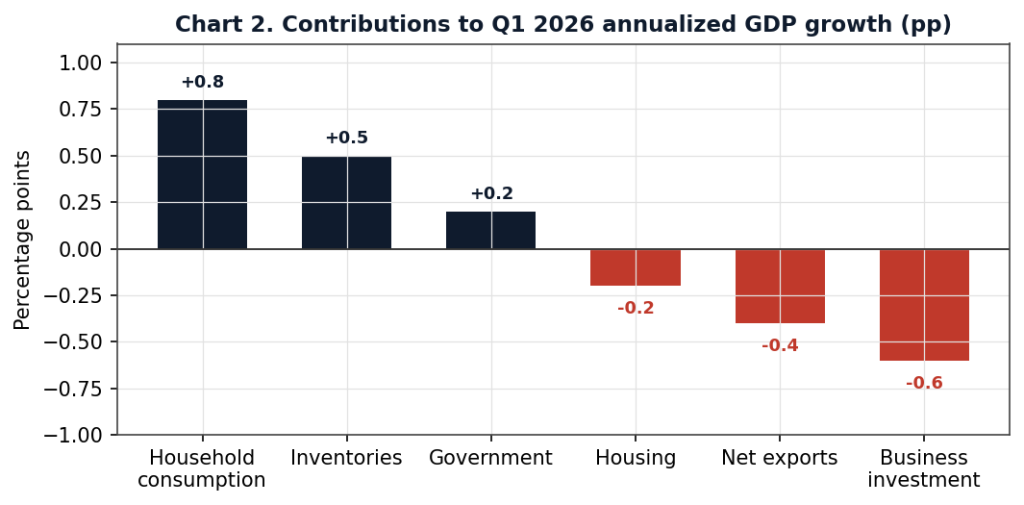
Contributions to Q1 2026 growth. Blue = added to growth; red = subtracted. Households kept spending; businesses and trade pulled back.
If this were a typical recession, households would be the problem — people losing jobs and cutting back. Here it’s the opposite. The weakness sits squarely in business investment (companies holding off on spending) and trade (a surge in imports, led by gold).
Why it matters: the tariff effect, measured
The paper doesn’t just assert that tariffs are the culprit — it measures it. Using a simple, transparent statistical model on 15 years of quarterly data, the analysis isolates the effect of the US tariff escalation that began in spring 2025. The result: the tariff environment is linked to roughly 1.4 percentage points of lost annual growth.
Put concretely: if you switch the tariff effect off in the model, the forecast for spring 2026 jumps from around +0.1% to about +1.4%. That gap is the price tag of the trade fight — and it’s the single most important number in the paper.
What it means, for three kinds of reader
| If you are… | The takeaway |
|---|---|
| An ordinary Canadian | Don’t panic. A sharp crash is unlikely. Expect slow, uneven growth rather than disaster. The job market is holding up. |
| A policymaker | The problem is business and trade confidence, not consumer demand. Trade stability and lower costs of doing business will help more than broad stimulus. |
| A bank or lender | Plan for a long, slow stretch rather than a deep recession. The risk is concentrated in trade-exposed industries and rate-sensitive lending like housing. |
Every figure in this brief comes from the underlying working paper’s own data and analysis.
The bottom line
Canada’s “technical recession” is real on paper but mild in substance. It’s best understood as an economy that has stalled under the weight of a trade-policy shock, not one that is collapsing. The headline says crisis; the data say slow, and fixable — if trade tensions ease.
Read the full analysis. This brief summarizes Streetwise Economics Working Paper 2026-02, which includes the full models, charts, forecasts, and a complete data and code appendix for replication. Available at streetwiseeconomics.com Click here to download full paper :
About the Author & Streetwise Economics
Isaac Jonas is an applied economist and the founder and principal consultant of Streetwise Economics, an independent economic research, advisory, and content practice based in Abbotsford, British Columbia. His work spans applied econometrics, regional and labour-market analysis, policy research, and strategic advisory for financial institutions, government agencies, and development partners in Canada and internationally.
He holds a Master of Food and Resource Economics (UBC), an MA in Resource, Environment and Sustainability (UBC), and a BSc in Economics (University of Zimbabwe), and is a Mastercard Foundation Scholar.
Available for consulting. Streetwise Economics works with organizations that need rigorous, decision-ready economic analysis — GDP and labour-market nowcasting, regional and sectoral monitoring, econometric modelling, and policy-impact evaluation — delivered on a transparent fixed-fee basis. To discuss a project, get in touch below.
Email isacjonasi@gmail.com Web www.streetwiseeconomics.com
LinkedIn linkedin.com/in/isaac-jonas-39443236 Substack isacjonasi.substack.com
Leave A Comment