

Why Alphabet Is Raising $80 Billion — and Whether It Makes Sense
By Isaac Jonas, Principal Economist, Streetwise Economics
On 1 June 2026, Alphabet — the parent of Google — said it plans to raise roughly $80 billion in fresh equity to fund its artificial-intelligence build-out. For a company sitting on hundreds of billions in cash and one of the most profitable business models in history, the obvious question is: why does Google need to raise money at all? The answer says a great deal about where the AI race is heading.
What is actually being raised
The $80 billion comes in three parts. First, a $30 billion underwritten public offering, split evenly between convertible preferred stock and common shares. Second, a $40 billion at-the-market (ATM) programme for common stock, expected to begin in the third quarter of 2026. Third, a $10 billion private placement bought directly by Warren Buffett’s Berkshire Hathaway, priced at $351.81 for Class A shares and $348.20 for Class C. The proceeds are earmarked for capital expenditure — chiefly data centres and AI compute — alongside general corporate purposes.
Why equity, and why now
This is the part the headlines miss. Alphabet is not raising money because it is short of cash; it is choosing equity over more debt. Over the past year the company raised more than $85 billion of debt across six currencies, lifting total debt above $100 billion. As the chart below shows, long-term debt sat quietly between roughly $11 billion and $13 billion for years, then jumped to $46.5 billion in 2025 and to $77.5 billion by March 2026. Loading another $80 billion of borrowing on top of that would strain the balance sheet and risk pressure on Alphabet’s pristine credit rating. Issuing equity keeps the balance sheet healthy — which is exactly why management is reaching for it.
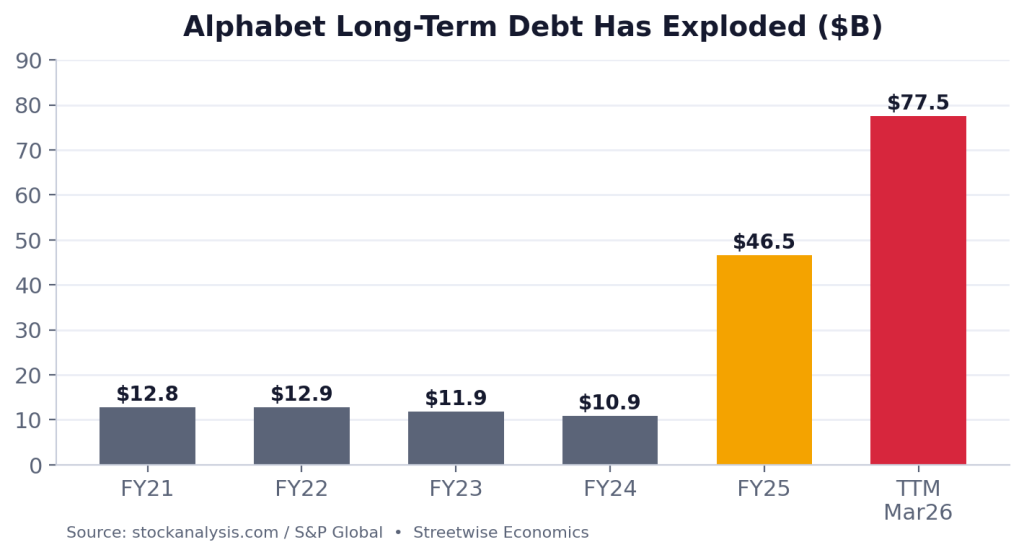
Alphabet’s long-term debt, FY2021–March 2026. Source: stockanalysis.com / S&P Global.
The financial backdrop
None of this stems from weakness. Over the trailing twelve months Alphabet generated about $422.5 billion in revenue and $160.2 billion in net income, a net margin near 38 percent, with operating cash flow of roughly $174 billion. Revenue grew 22 percent year-on-year to $110 billion in the first quarter of 2026; Google Cloud grew 63 percent, with backlog approaching $460 billion. The business is a near-monopoly advertising engine that funds everything else, now supplemented by a fast-growing cloud and a 350-million-strong subscription base. The constraint is not profitability — it is the sheer scale of capital the AI era demands. Management guided 2026 capital expenditure to $180–190 billion and signalled a further step-up in 2027.
The Berkshire question: dilution or conviction?
Issuing new shares is dilution, plain and simple: each existing share ends up owning a slightly smaller slice of the company, and the market nudged the stock lower on the news. That concern is legitimate and worth stating clearly. But I read the Berkshire placement as a strategic positive rather than a worry. A $10 billion cheque from the most patient capital allocator in the world is a strong signal as the AI narrative unfolds. The dilution is real; the logic behind it — buying the compute to meet demand that is already outrunning supply, without breaking the balance sheet — is sound.
The competitive frame
Alphabet is not raising in a vacuum. Across the AI landscape, capital is being mobilised at a staggering pace. SpaceX is targeting a roughly $2 trillion valuation and a raise near $75 billion; OpenAI has pulled in about $122 billion at an $852 billion valuation; and Anthropic recently raised around $65 billion near a $965 billion valuation ahead of a potential listing. Industry estimates put total AI capital expenditure above $800 billion in 2026 and beyond $1 trillion in 2027. In that company, Alphabet’s edge is obvious: it can fund its ambitions from cash flow that its rivals can only dream of, and tap equity markets on its own terms rather than out of necessity.
My take
On balance, I think raising the money is the right call. Compute is the bottleneck of the AI era, demand is real, and under-building would be the bigger mistake. Choosing equity protects the balance sheet after a year of heavy borrowing, and the Berkshire vote of confidence reinforces the case. The risks are equally real: capital-expenditure discipline, cloud margins, and whether AI revenue keeps pace with the spend are the variables I am watching. I hold a small position, and I see this as a sound strategic move as the story unfolds — but markets do not reward conviction without scrutiny.
About the author
Isaac Jonas is Principal Economist at Streetwise Economics, an applied-economics consultancy offering valuation analysis, financial modelling, impact evaluation and economic research for businesses, investors and institutions. For consulting enquiries, visit streetwiseeconomics.com or email isacjonasi@gmail.com.
Disclaimer: This article is for educational and informational purposes only and does not constitute investment advice or a recommendation to buy or sell any security. Investing involves risk, including the possible loss of capital. All figures are as of June 2026 and drawn from public sources. Always do your own research or consult a licensed financial adviser before making investment decisions.
Leave A Comment