

A Legal Shock in a Market Built on Fragile Confidence
The U.S. equity market entered 2026 walking a tightrope. Valuations were stretched, leadership was narrow, artificial intelligence continued to dominate capital allocation, and geopolitical risk lingered just beneath the surface. Then came a curveball few investors had fully priced in: a landmark ruling by the Supreme Court of the United States striking down large portions of President Donald Trump’s global tariff regime.
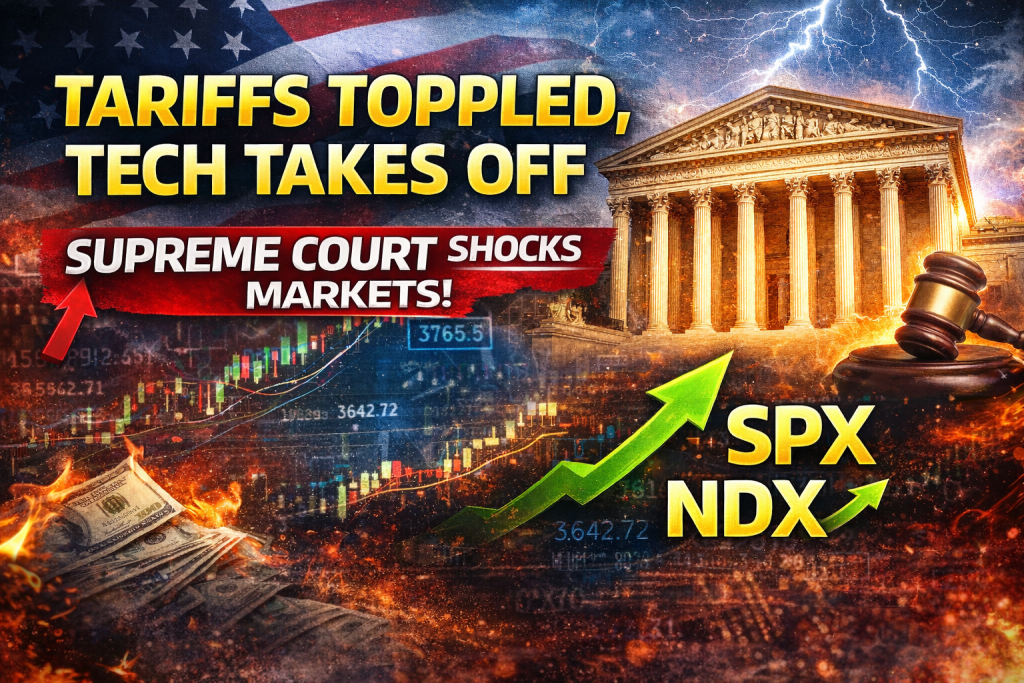
For market participants watching the S&P 500 (SPX) and the Nasdaq 100 (NDX), the ruling is not about legal theory. It is about how quickly markets reprice trade risk, how sector leadership shifts, and how policy uncertainty interacts with already-elevated volatility. In a market where narratives can flip on a single headline, this decision adds a new—and consequential—variable.
This article is for educational purposes only. The goal is not to predict market direction, but to understand how risk may evolve in response to legal, political, and geopolitical shocks.
What the Supreme Court Actually Ruled—and Why It Matters
In a 6–3 decision, the Supreme Court found that the Trump administration exceeded its authority by using the International Emergency Economic Powers Act (IEEPA) to impose sweeping, long-lasting tariffs on imports from a wide range of U.S. trading partners. The Court’s message was direct: if Congress intends to grant a president such expansive tariff powers, it must do so explicitly. This statute did not.
Practically, the ruling invalidates a significant portion of the administration’s “global” and “reciprocal” tariff framework. More narrowly tailored tariffs—such as certain steel and aluminum measures imposed under different statutory authorities—remain intact. But the broader architecture that underpinned Trump’s trade strategy has been weakened.
This decision also raises the possibility of tariff refunds for importers who paid duties now deemed unlawful. Over time, that could influence corporate cash flows, pricing decisions, and margins—particularly for multinational firms embedded in global supply chains.
Politically, Trump has denounced the ruling and signaled that the White House will explore alternative legal pathways to re-impose tariffs under other trade statutes. In other words, the tariff story is not ending; it is mutating. For markets, that distinction matters.
SPX: A Calm Index Masking Internal Turbulence
At the index level, the S&P 500 has appeared remarkably stable, hovering near record highs in early 2026. At time of writing SPX was trading at 6,909 points, 0.70% up from yesterday. But that calm is deceptive.
Under the surface, internal dispersion has been extreme. On several sessions, dozens—sometimes over a hundred—S&P constituents have experienced sharp drawdowns even as the index itself barely moved. This is not a market exiting equities wholesale; it is a market rotating aggressively beneath the headline number.
The tariff ruling adds a new dimension to that rotation. Reduced trade friction generally benefits large-cap multinationals by easing supply-chain costs and improving margin visibility. Industrials, exporters, and domestically focused cyclicals may see renewed interest if investors believe global trade conditions are stabilizing.
At the same time, legal uncertainty cuts both ways. The ruling introduces a new form of policy risk: not just what the administration wants to do, but what it is legally allowed to do, and how long any workaround might survive judicial scrutiny. For SPX, already dependent on a narrow group of mega-cap leaders, that uncertainty increases the importance of diversification and risk control.
NDX and Big Tech: Relief, But With Higher Expectations
The Nasdaq 100 has been the structural outperformer of the post-pandemic era, driven by AI, cloud computing, and platform-based business models that are less sensitive to traditional tariffs than old-economy manufacturing.
During periods of heightened trade tension in 2025, tech frequently led rebounds as investors treated it as a relative safe haven within equities. Demand for chips, data infrastructure, and software appeared resilient even as tariff headlines dominated the news cycle.
With much of the global tariff framework now struck down, the near-term backdrop for NDX looks more supportive. Reduced risk of sudden cost shocks, smoother global supply chains, and a lower probability of retaliatory measures targeting digital services all favor large technology firms.
However, this relief comes with a trade-off: expectations are now extremely high. Valuations remain elevated, earnings strength is already priced in, and regulatory scrutiny has not disappeared. The tariff ruling removes one headwind, but it does not insulate tech from broader macro shocks or policy shifts. In a risk-off event, high-valuation names can still experience outsized drawdowns.
Trump’s Market Agenda After the Ruling
From a political standpoint, the decision represents a rare institutional check on a president who has generally benefited from a conservative Court majority. From an economic perspective, it forces a rethink of how trade policy fits into the broader “America First” agenda.
The administration has warned that the ruling could complicate trade negotiations and delay existing agreements. Trump has also suggested that alternative statutes—those granting narrower but clearer authority—may be used to restore parts of the tariff regime.
For markets, this implies a shift from sweeping, unilateral trade actions to a more piecemeal and legally constrained approach. Investors must now evaluate not just the intent of policy, but its durability. How long will a given tariff last before being challenged? What sectors are exposed to that uncertainty? These questions will increasingly influence both SPX and NDX pricing.
The Geopolitical Wildcard: A Potential Iran Escalation
Overlaying trade and legal risk is a geopolitical tail risk that markets cannot ignore: the possibility of a direct U.S. military strike on Iran.
While not a base case, such an escalation would likely have immediate market consequences. Energy prices could spike as traders price in threats to Gulf production and shipping lanes. Risk-off flows would likely favor U.S. Treasuries, gold, and the dollar—at least initially.
For SPX, higher energy costs and weakened global confidence could pressure earnings in transportation, consumer discretionary, and energy-sensitive industrials. For NDX, the picture would be mixed: tech’s structural growth profile may offer relative support, but broad de-risking could still weigh on high-multiple names.
In such a scenario, the tariff debate would temporarily fade, replaced by classic macro and geopolitical risk dynamics.
Risk Management Over Prediction
Against this backdrop—shifting tariffs, legal uncertainty, elevated valuations, and geopolitical tail risks—the central challenge for investors is not prediction. It is process.
Markets do not require you to forecast Supreme Court rulings or military decisions with precision. They require you to manage exposure so that no single outcome can end your participation.
That means:
- Position sizing: risking a defined, limited portion of capital on any single idea.
- Diversification: across sectors, factors, and geographies, so returns are not tied to one narrative.
- Time-horizon alignment: recognizing that short-term traders and long-term allocators process the same headline very differently.
The objective is not to be right about every event. It is to remain solvent, disciplined, and adaptable as events unfold.
Final Thoughts
The Supreme Court’s decision to strike down large portions of Trump’s tariff regime is a reminder that markets operate within institutional boundaries, not just political ambition. For SPX and NDX, the ruling reshapes trade risk, alters sector leadership, and introduces a new layer of legal-aware policy uncertainty.
Tariffs, courts, and geopolitics will continue to generate headlines. Investors cannot control those forces. They can control leverage, exposure, and decision-making discipline.
Understanding what you own—and why you own it—matters more than reacting to every shock.
Learn More with Streetwise Economics
If you want ongoing, plain-language breakdowns of macro cross-currents—tariffs, central banks, geopolitics, and sector rotation—follow Streetwise Economics on YouTube. Each week, we focus on frameworks rather than forecasts, helping investors and traders think clearly in uncertain markets.
Isaac Jonas is a Zimbabwean‑Canadian economist and retail investor, and the founder of Streetwise Economics, an independent platform focused on practical investing, risk management, and market awareness. Based in Canada, he shares insights from global markets through his YouTube channel and written research, helping everyday investors make informed, disciplined decisions about money and capital allocation. For professional enquiries, he can be reached at isaacjonasi@gmail.com. This article is for educational purposes only and does not constitute investment advice. You should consider your own financial circumstances and consult a licensed professional where appropriate.
Leave A Comment