

By Isaac Jonas | Streetwise Economics | April 8, 2026
www.streetwiseeconomics.com | YouTube: Streetwise Economics

The morning of April 8, 2026 will be remembered in financial markets for years.
After five weeks of war, a closed Strait of Hormuz, and oil prices threatening to breach $120 per barrel, US President Donald Trump posted on Truth Social that he was suspending military operations against Iran for two weeks after receiving a ten-point proposal from Tehran he described as “a workable basis for negotiations.” Iran agreed to reopen the strait. Pakistan brokered the deal. And markets exploded upward in one of the sharpest single-day moves in recent memory.

All figures in this report are as of April 8, 2026, at the time of writing. Markets remain dynamic and numbers may shift.
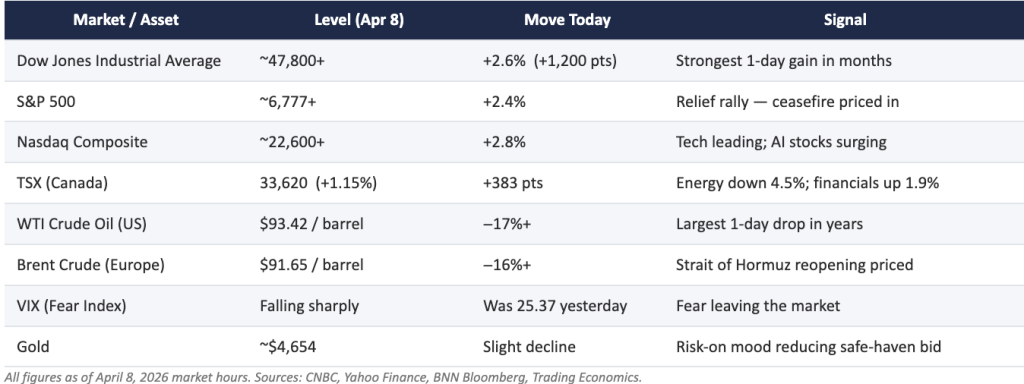
United States — The Biggest Single-Day Move in Months
The US stock market reaction was swift and dramatic. The Dow Jones Industrial Average surged more than 1,200 points — a gain of 2.6% — its best single-day performance in months. The S&P 500, which tracks 500 of America’s largest companies, jumped 2.4%. The technology-focused Nasdaq climbed 2.8%, led by chipmakers and AI-related stocks. Nvidia and AMD surged between 4% and 10% at the open.
The logic is straightforward. The ceasefire means the Strait of Hormuz — through which roughly 20% of the world’s oil normally flows — is reopening. That reduces the energy-driven inflation that has been squeezing consumers and complicating the Federal Reserve’s decision-making. Lower inflation expectations mean lower interest rate pressure. Lower rates are good for stocks, especially growth and technology stocks. The market moved quickly to reprice all of this.
Airlines were among the biggest winners. Delta Air Lines surged 12% after reporting strong earnings combined with the ceasefire news — jet fuel costs are their biggest expense, and cheaper oil is a direct profit driver. Healthcare stocks also jumped sharply on what analysts called a broader return of risk appetite.

Canada — A Split Picture on the TSX
The Canadian market tells a more nuanced story. The S&P/TSX Composite Index closed April 8 at 33,620 — up 1.15% or 383 points. But beneath that headline number lies a sharp divide between sectors.
Canada’s energy sector fell 4.51% on the day. This makes sense: Canadian oil producers — companies like Canadian Natural Resources, Suncor, and Imperial Oil — had been major beneficiaries of the war-driven oil price surge. With WTI crude falling from $115 to $93 in a single session, their revenue outlook took an immediate hit. The trade is straightforward: oil up = energy stocks up. Oil down = energy stocks down.
However, the Canadian financial sector gained 1.88%. Banks like RBC and TD benefited from the improved economic outlook and reduced stagflation fears. Shopify and other technology names also recovered ground. For Zimbabwean readers watching Canada: the Canadian dollar and commodity-linked assets will be sensitive to whether this ceasefire holds. If oil stays low, the loonie may soften slightly.
Global Markets and Oil — The Sharpest Single-Day Move Since 2022
The oil market’s reaction was extraordinary. WTI crude fell more than 17% in a single session — from around $114 to $93.42 per barrel. Brent crude, the European benchmark, fell more than 16% to $91.65. These are moves not seen since the chaotic early days of the Russia-Ukraine war in 2022.
For context: before the US-Iran war began in late February 2026, oil was trading around $75–$80 per barrel. Five weeks of Strait of Hormuz closure pushed it as high as $115 with analysts warning it could reach $200 if the conflict lasted through June. Today’s retreat brings it back toward a more normal range — though still elevated compared to pre-war levels.
European markets reacted positively as lower energy costs ease pressure on the European Central Bank. Asian markets opened sharply higher as export-dependent economies priced in reduced shipping costs and supply chain relief.
The Monte Carlo Framework — What Happens Next?
At Streetwise Economics, we use Monte Carlo simulation — a tool that runs thousands of possible future scenarios — to think about market probabilities rather than predictions. Here is how the scenarios look today, at the time of writing.

The single most important thing to understand about today’s rally is what the strategist Ed Yardeni said this morning: ‘A two-week pause is not a resolution.’ Vice President JD Vance described the ceasefire as a ‘fragile truce.’ Markets are not celebrating peace — they are celebrating the possibility of peace. That is a meaningful distinction for any investor.
The Lesson Nobody Talks About
The people who made the most money today are the ones who had the courage — and the capital — to buy stocks when war was raging and fear was highest. Institutional investors, hedge funds, and disciplined private investors were accumulating positions in March and early April when everyone else was selling. Today is their payday.
This is not unfair — it is how markets are designed to work. They reward people who understand the difference between temporary fear and permanent damage, and who can control their emotions when the noise is loudest. The only way to participate in these moments is to do the work in advance: understand what you own, understand why you own it, and know what price would mean the story has changed.
For everyday investors, the takeaway is simple: the next opportunity like this will come. Not from this specific conflict, perhaps, but from the next one. When it does, will you be ready?

For the Week Ahead
Watch April 10 closely — the March CPI report drops that morning. If inflation comes in hot (driven by five weeks of $110+ oil), the Federal Reserve will be in a difficult position even with the ceasefire in place. This is the next major market event. I will cover it live on the Streetwise Economics YouTube channel — subscribe so you do not miss the analysis.
For deeper reports, scenario modelling, and market analysis, visit www.streetwiseeconomics.com. If you are interested in personal coaching on understanding markets and building your financial knowledge, coaching services are available through the website.
Remember: everything in this column is my personal view as an economist. Not investment advice. But always honest, always evidence-based, and always in plain language — because you deserve the same quality of thinking that wealthy investors access every day.
Isaac Jonas is the founder of Streetwise Economics. He holds dual Master’s degrees from UBC and writes weekly on economics, markets, and financial literacy. Website: www.streetwiseeconomics.com | YouTube: Streetwise Economics
Leave A Comment